
Introduction
With new aviation academies opening across the country every year, finding the best aviation institute in India can feel like finding a needle in a haystack. Every institute claims to be number one, but very few can back that claim with real numbers, real placements, and real infrastructure.
Choosing the wrong institute can cost you a full year and a significant amount of money. This guide breaks down exactly what to check before you pay a single rupee in fees — whether you’re evaluating an academy in Delhi, Mumbai, Indore, or any other city in India.
Top Aviation Career Options in India
Before choosing an institute, it helps to know which career path fits you best. The three most common entry points into the aviation industry are:
- Cabin Crew / Air Hostess Training — client-facing, in-flight service and safety role. See our full Cabin Crew Course details for eligibility, duration, and fees.
- Pilot Training — a longer, more technical path with higher upfront investment. Explore the Pilot Training Course page for licensing requirements and course structure.
- Airport Management — ground operations, passenger handling, and logistics roles that don’t require the height or age restrictions of cabin crew. Check the Airport Management Course page for details.
6 Factors to Check Before Choosing an Aviation Institute
1. Ask for Verified Placement Proof
Don’t settle for verbal promises. Ask to see actual placement records — photos of placed students, offer letters, or a public “Placement Hall of Fame.” At DFLY International, we maintain a 95% placement record and showcase it transparently rather than just claiming it.
2. Check for Hidden Costs
Many institutes advertise a low aviation academy fee upfront, then add charges later for uniforms, exams, or grooming kits. Always ask for the complete, final package price before enrolling. At DFLY, what we quote is what you pay — there are no surprise charges added after admission.
3. Confirm Practical Training Infrastructure
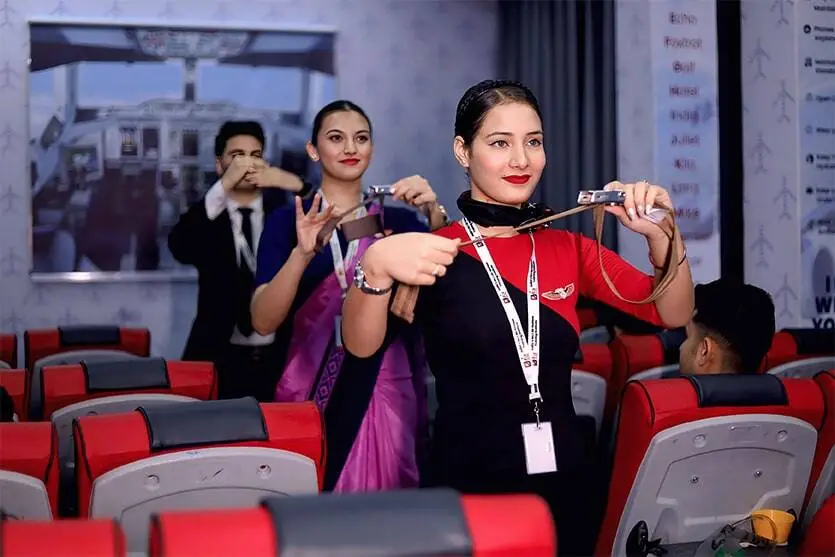
Aviation is a hands-on profession. Ask whether the institute has a mock aircraft cabin setup, and whether grooming and swimming are taught practically, not just in theory. Classroom learning alone will not prepare you for an airline interview or the job itself.
4. Check Accreditation and Industry Recognition
Verify that the institute is recognized within the industry and has genuine airline or airport tie-ups for interviews and placement drives, rather than only offering a generic completion certificate.
5. Look at Campus Reach and Consistency
An institute with multiple campuses across India — rather than a single branch — usually reflects a training standard that has been tested and repeated successfully across different cities and student intakes.
6. Confirm the Curriculum Is Current
Airline hiring standards, grooming expectations, and interview formats change over time. Make sure the curriculum has been updated for 2026 airline requirements, not left unchanged for several years.
DFLY vs. What to Look For — Quick Comparison
Criteria | What to Look For | How DFly International Delivers |
Placement Record | Verified proof, not verbal promises | 95% placement record, documented student placements |
Fee Transparency | One final number, no hidden add-ons | What we quote is what you pay — no surprise charges |
Practical Training | Mock aircraft cabin, grooming labs, swimming | Hands-on cabin crew and ground simulation setup |
Campus Reach | Multiple cities, consistent training standard | Expanding Across Major Cities in India & Dubai |
Curriculum Currency | Updated for current airline hiring standards | Curriculum refreshed for 2026 airline requirements |
Why Students Across India Choose Dfly international ? We offer a blend of affordable fees, no hidden charges, and a training curriculum that is updated for 2025 airlines standards. Whether you are from a big city or a small town, our training levels the playing field.
Want to See Our Campus? Seeing is believing. Come visit us or take a virtual tour to talk to our current students.
Frequently Asked Questions
Check verified placement proof, confirm there are no hidden fees, look for practical (not just theoretical) training, and make sure the curriculum is updated for current airline standards.
Fees vary by course and city — cabin crew courses, pilot training, and airport management programs are each priced differently. Always request the complete, final package price rather than a starting figure.
Cabin crew and airport management courses typically run a few months to under a year, while pilot training programs take significantly longer due to licensing requirements.